






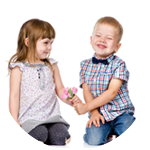
Autistic Child and Babies: Obsession or Attachment?
Even a small child who has learned to crawl differs significantly from a newborn. There is almost nothing in common between older children and infants. Nevertheless, sometimes it is precisely these little ones who attract an unusually intense interest from autistic children, who may be indifferent to their peers but show tenderness and care toward defenseless beings—feelings that can hold great meaning for them. There are many reasons for such behavior.
- Predictability and simplicity of behavior
Babies have simple, repetitive needs and expressions (crying, cooing, sleeping, eating). This predictability can be perceived as safe and manageable compared to complex social interactions with peers. - Understanding of nonverbal signals
Autistic individuals often understand nonverbal cues well. Babies communicate mainly through sounds, facial expressions, and body language, which may seem more intuitive or less overwhelming than complex verbal communication. - Sensory experiences
Babies usually have soft skin, a pleasant scent for some, and emit repetitive, often soothing sounds (cooing, babbling). This sensory input can be attractive. - Observing development
Rapid and noticeable developmental milestones in babies (learning to smile, roll over, crawl, walk, talk) can be fascinating for those who enjoy systematic observation and attention to detail. - Playing with baby dolls or watching real infants
This allows the child to practice roles, understand cause-and-effect relationships (“the baby cries, then it is fed”), and explore social concepts in a controlled way. - Exploring identity questions
Some autistic children, especially those who feel different from their peers, may subconsciously associate themselves with babies due to their preverbal stage, dependency, or direct emotional expressions. They may see babies as beings who do not judge them. - Desire for personal comfort
This is not selfish; the idea of babies or caring for baby dolls can be inherently comforting and evoke nurturing feelings, satisfying emotional needs. - Pure fascination
Sometimes the interest is simply deeply captivating for reasons unique to the child—such as the babies’ appearance or movements.
To support the child, it is important first to acknowledge and encourage this interest, provided it does not lead to negative behaviors. To wean the child from contact with real babies, role-playing with dolls and related accessories can be organized. Older children might benefit from reading books about baby care and development. To foster responsibility, the child can be involved in caring for a baby under supervision or given a pet to care for, providing an outlet for nurturing needs. Sometimes, redirecting attention to creative activities—drawing babies, writing stories about them, or making crafts—may suffice.
It is crucial to clearly explain that the child must never approach, touch, or hold someone else’s baby without explicit parental permission. These scenarios can be rehearsed using social stories or visual cues. Practice with a familiar baby is possible but only under constant adult supervision. Above all, the child must learn to respect the baby’s personal space and need for calm.
In most cases, fascination with babies is a healthy “special interest” that can be supported and directed positively. Providing safe opportunities for expression, teaching essential boundaries, and linking the interest to learning and social understanding helps the child navigate the social world. However, it should not be forgotten that such a narrow interest, like others, is a symptom of autism spectrum disorder and can develop to the detriment of other interests, limiting the child’s outlook. Therefore, the primary task is to address autism and its manifestations, which—as has been shown—can be done most effectively with the latest, safest, and most natural approach.
This approach is known as cell therapy, which offers the chance to overcome the disorder in the shortest time with the highest chance of success. It is based on stem cell transplantation—the body’s fundamental elements capable of transforming into any other cell types and replacing damaged cells with healthy ones. Importantly, the patient’s own stem cells are used, eliminating rejection risks, and healing occurs by stimulating natural regenerative capacities.
Soon after the procedure, encouraging changes occur—the brain and nervous system functions normalize, allowing accurate information processing and appropriate responses. Behavior stabilizes, the speed of development and skill acquisition increases, and symptoms of the disorder become less severe or often disappear entirely. These positive effects last for many years, often for life, increasing the effectiveness of additional corrective measures.
Today, cell therapy is no longer experimental but a widely recognized method for treating autism and its symptoms and may become the primary approach, more effective than all others. It is practiced by leading clinics worldwide, including the Mardaleishvili Medical Center, where highly qualified doctors possess extensive successful experience with stem cell transplantation and use the most advanced equipment to achieve the best possible therapeutic outcomes. Treatment conditions meet the highest international standards, and costs are lower compared to other countries with advanced healthcare systems. Also important is the comprehensive support provided in planning trips and handling other logistics, including accommodation during rehabilitation.
Cell therapy is a guarantee of harmonious personal development!
Autism Treatment Center Videos
Autism treatment with own stem cells
Cord blood association congress
International Quality Crown
Autism Treatment Reviews
Autism treatment with own stem cells
The story of Alessandro (6 years old)
Autism Patient Testimonial - Stem Cell Treatment
Clients Testimonials
Feedback from Tatyana, Mekan’s mother (5 years old) Read More
Lidiya — Elina’s mother Read More
Anna – Sasha’s mother Read More
Amirkhon’s father — Tokhir Read More
Dilana’s mother Read More
Irina and Stefan – Ilya’s parents Read More
Certificates And Licenses